Meta title (60 chars): Nissan Leaf Battery for Home Solar Storage — 2026 Guide
Meta description (155 chars): Turn your Nissan Leaf battery (24, 30, 40, 62 kWh) into home solar storage. Full step-by-step guide: costs, ROI, BMS setup, safety, and legal side.
URL slug: `nissan-leaf-battery-home-solar-storage-guide`
Category: Blog / Battery Guides
Tags: Nissan Leaf, home energy storage, solar storage, BMS-EV, 2nd-life batteries
Why the Nissan Leaf battery is one of the best 2nd-life options
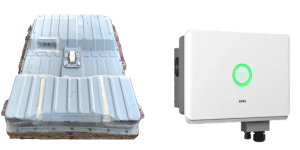
Since 2010, Nissan has sold over 700 000 Leafs worldwide. The battery pack (24, 30, 40, or 62 kWh depending on model year) uses automotive-grade LG or AESC lithium NMC/LMO cells — the same chemistry used in modern home battery products like Tesla Powerwall.
Key advantages:
- Robust construction: liquid-cooled or air-cooled aluminium enclosure, IP67 rated
- Standard CAN bus communication — well-documented reverse-engineering
- Available cheap on the used market (€1 500–€4 500 for a 40 kWh pack in 2026)
- State of Health (SoH) 75–90% in most 5–8 year old packs — still 30–56 kWh usable
Compared to a new Tesla Powerwall 3 (13.5 kWh, ~€10 000 installed), a 40 kWh Leaf pack for solar storage costs roughly €3 500–€5 500 total including BMS, inverter integration, and enclosure.
Realistic total cost: DIY vs pre-built
For a 40 kWh Nissan Leaf home storage system in 2026:
| Component | DIY cost | Pre-built cost |
|---|---|---|
| Used Leaf 40 kWh pack | €3 200 | €3 500 |
| BMS-EV Controller | €500 | €500 |
| Hybrid inverter (Sofar HYD 10 KTL-3PH) | €2 100 | €2 300 |
| Enclosure, cables, fuses | €600 | €900 |
| Installation (electrician) | €500 self | €1 500 |
| TOTAL | €6 900 | €8 700 |
Compare this to buying the same 40 kWh capacity in new LiFePO4 batteries (Pylontech, BYD, Growatt): €14 000–€18 000 installed.
You save €7 000–€11 000 on a system that will run for 8–12 more years with proper BMS management.
Safety: don’t skip this section
Second-life EV batteries store 35–60 kWh at 350–400 V DC — enough to weld metal and enough to kill. Follow these rules or hire a certified installer.
- Always test SoH first — reject any pack with SoH <70%, imbalanced cells, or thermal damage signs (swollen modules, discoloration)
- HV isolation gloves and insulated tools (Class 0, 1 000 V rated) during install
- Ground the enclosure and pack chassis to your house ground
- DC-rated fuses only (AC fuses fail catastrophically on DC)
- Insulation monitor — a €200 device that detects insulation faults before they cause fires
- Smoke detectors + fire-rated enclosure if installed indoors
- Register the system with your local grid operator (mandatory in most EU countries)
The BMS-EV Controller actively monitors cell voltages, temperature, and current every 100 ms. It shuts down the pack automatically if any parameter goes out of range — the same safety layer used in commercial energy storage systems.
Common problems and how BMS-EV solves them
Problem 1: “The Leaf BMS refuses to wake up outside the car”
→ BMS-EV Controller emulates the missing CAN messages from Leaf’s VCM (Vehicle Control Module), so the original BMS thinks it’s still in the car and wakes up normally.
Problem 2: “How do I connect a HV pack to a 48V inverter?”
→ You don’t — you need a HV-input inverter (Sofar HYD, Deye SG01HP3, Fronius Symo Gen24). BMS-EV Controller has native support for all common HV inverters.
Problem 3: “The pack won’t balance — one module is always higher”
→ BMS-EV Controller has active passive balancing (dissipates excess energy from high cells) during charging. Watch the BMS-EV Cloud dashboard to verify balancing is working.
Problem 4: “State of charge (SoC) reading drifts over time”
→ BMS-EV Controller re-calibrates SoC from open-circuit voltage every time the pack rests >30 min above 90% or below 10% — no manual reset needed.
Real customer case: 40 kWh Leaf + Sofar HYD 10 KTL-3PH
A customer in Poland installed a 2019 Nissan Leaf 40 kWh pack (SoH 84%) with Sofar HYD 10 KTL-3PH and BMS-EV Controller in June 2026.
- Total cost: €5 800 (DIY installation with electrician for final commission)
- Solar PV array: 12 kWp
- First-month self-consumption: rose from 34% to 82%
- Grid electricity saved: 340 kWh in first 4 weeks
- Projected annual savings: €1 250
- Payback estimate: 4.6 years
Full case study with photos: BMS-EV Blog Case Studies
Ready to build your Nissan Leaf home storage?
The BMS-EV team has helped 300+ controllers delivered across 26 countries turn Nissan Leaf batteries into working home solar storage systems. Every controller ships pre-configured for your specific battery + inverter combo.
Browse Nissan Leaf compatible controllers:
👉 BMS-EV Controllers for Nissan Leaf — all inverter combos, from €500
Not sure which combo you need?
👉 Contact us with your battery + inverter details — free consultation.
—
Related guides
- Complete guide to EV battery reuse for home energy storage (pillar)
- BMS-EV Battery Monitor — real-time cell-level data
- BMS-EV Cloud — remote monitoring for your storage
Technical corrections (audit 2026-09-18):
- Commissioning current: “Start with 10-20 A and ramp up” is a rule-of-thumb, NOT a universal recommendation. Actual starting current must be defined by the specific battery + inverter pair: typically ~10 % of nameplate. Verify pack limits (OEM BMS), inverter limits (datasheet), contactor operation, thermal behaviour and fault-free CAN communication for at least 24 h before increasing current.
- Commissioning time: “Under 30 minutes setup” applies to the BMS-EV web interface configuration only. Full commissioning time (physical installation, cable runs, safety checks, first grid-tie test, load-test) is inherently longer and depends on the specific system and applicable local standards.
- HV connectors: “Amphenol Powerlok or equivalent” — for actual installation the connector must be rated for the specific pack maximum voltage (≥1000 V DC for Tesla/BMW/MEB, ≥1500 V DC for E-GMP 800 V-class packs), continuous current per pack spec (≥200 A for Tesla LR NCA), touch-safe (IP2X), UL 4128 or IEC 62196 compliant. Verified alternatives: TE HVA630/HVA280, Rosenberger RoPD, Yazaki HV connectors. Do NOT use MC4 solar connectors (30 A / 1500 V, not touch-safe).
- Cable sizing: conductor cross-section must be calculated for the actual maximum current, cable length, installation method, ambient temperature and applicable local standards (IEC 60364-7-712, VDE-AR-N 4105, NEC 690).
- Cell voltage / SoC / balance: generic values (e.g. “3.7 V × 96”, “±20 mV”) are simplifications — always verify against the OEM BMS specification for the exact pack revision.
Find the controller for your battery
Pick the make of the pack you are building your storage from.
See all controllers 70 battery profiles · 56 inverters · code BLOG5 gives 10% off