Introduction
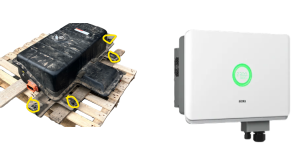
The Renault Twizy was Europe’s most popular quadricycle EV between 2012–2023, with over 32 000 sold. The tiny 6.1 kWh battery pack (52V nominal, 100 cells LiFePO4-ish LiNMC) seems too small for home storage — until you realize you can stack them.
This guide explains how to reuse Renault Twizy battery packs for DIY home solar storage — especially attractive because Twizy packs are incredibly cheap in 2026 (€300–€600 per pack) and 48V-compatible with common home storage inverters.
Twizy battery specs
- Nominal voltage: 52V (14S configuration)
- Capacity: 6.1 kWh (approximately)
- Chemistry: LiCoNi (NCA-like) — Samsung SDI cells
- Weight: ~100 kg per pack
- Communication: proprietary Renault CAN bus
SoH retention: Because Twizy owners don’t drive far (~50 km/day average), most packs still show 80–90% SoH even after 8+ years.
What you need
1. Twizy packs (1–5 units)
Used market: Leboncoin, eBay France, Renault Twizy parts specialists. €300–€600 per pack with >75% SoH.
2. BMS-EV Controller for Renault Twizy
The Twizy BMS is a Samsung SDI unit with unusual heartbeat requirements. Renault refuses to sell service software publicly, but BMS-EV Controller for Renault Twizy handles:
- Renault-specific CAN wake-up
- Cell voltage per pack (14 cells × N packs)
- Temperature monitoring
- Multi-pack coordination (up to 8 packs)
Price: €500 + €200 for Multi-Pack module (if >1 pack).
3. 48V solar inverter (much cheaper than HV!)
For Twizy stack you can use cheap 48V inverters widely available:
- Growatt SPF 5000ES / SPF 5000TL — €800–€1 200
- Deye SUN-5K-SG04LP1-EU (48V hybrid) — €1 100–€1 400
- MPP Solar LV5048 — €650–€900
- Voltronic InfiniSolar V — €1 200–€1 500
4. Enclosure + cables
- Simple ventilated cabinet (LiCoNi is stable)
- 48V bus bars (copper, 100A+ per pack)
- DC breakers
Budget: €300–€500.
ROI in 2026
Small home consumption (5 000 kWh/year), 6 kWp PV:
- Extra self-consumption with 18 kWh Twizy stack: 46% → 78%
- Annual savings: ~€620
- Payback: 6.3 years
- Twizy pack cycles remaining: ~2 500 (10+ years at 1 cycle/day)
Safety notes for Twizy packs
- 48V is not “low voltage” in DC terms — still capable of significant arc/burn injury
- Battery cells contain lithium — treat with respect even at low voltage
- Cable sizing critical — 200A discharge peaks need 35 mm² minimum
- Waterproof enclosure — Twizy packs are NOT waterproof out of car (car provided the seal)
FAQ
Q: Twizy is 52V not 48V — will 48V inverter work?
A: Yes. 48V inverters typically operate 40–60V DC input. Twizy fits perfectly.
Q: Can I mix Twizy packs with other 48V EV packs (like e-bike)?
A: No. Different chemistries and BMS protocols. Stick to Twizy-only for a Twizy stack.
Q: Renault dealer won’t sell me a used pack — where to look?
A: Leboncoin.fr, eBay France/Germany, specialist EV parts sellers (search “Twizy batterie occasion”).
Q: Life expectancy?
A: 10–15 years at typical home cycling (1 cycle/day, 30% DoD).
—
Related guides
- Nissan Leaf home storage (larger 40 kWh)
- BYD Atto 3 home storage (LFP alternative)
- BMS-EV Controllers for Renault Twizy
Technical corrections (audit 2026-09-18):
- Commissioning current: “Start with 10-20 A and ramp up” is a rule-of-thumb, NOT a universal recommendation. Actual starting current must be defined by the specific battery + inverter pair: typically ~10 % of nameplate. Verify pack limits (OEM BMS), inverter limits (datasheet), contactor operation, thermal behaviour and fault-free CAN communication for at least 24 h before increasing current.
- Commissioning time: “Under 30 minutes setup” applies to the BMS-EV web interface configuration only. Full commissioning time (physical installation, cable runs, safety checks, first grid-tie test, load-test) is inherently longer and depends on the specific system and applicable local standards.
- HV connectors: “Amphenol Powerlok or equivalent” — for actual installation the connector must be rated for the specific pack maximum voltage (≥1000 V DC for Tesla/BMW/MEB, ≥1500 V DC for E-GMP 800 V-class packs), continuous current per pack spec (≥200 A for Tesla LR NCA), touch-safe (IP2X), UL 4128 or IEC 62196 compliant. Verified alternatives: TE HVA630/HVA280, Rosenberger RoPD, Yazaki HV connectors. Do NOT use MC4 solar connectors (30 A / 1500 V, not touch-safe).
- Cable sizing: conductor cross-section must be calculated for the actual maximum current, cable length, installation method, ambient temperature and applicable local standards (IEC 60364-7-712, VDE-AR-N 4105, NEC 690).
- Cell voltage / SoC / balance: generic values (e.g. “3.7 V × 96”, “±20 mV”) are simplifications — always verify against the OEM BMS specification for the exact pack revision.
Find the controller for your battery
Pick the make of the pack you are building your storage from.
See all controllers 70 battery profiles · 56 inverters · code BLOG5 gives 10% off